


Understanding One More Lever Behind Extract Quality
Among extractors, the phrase “cold makes gold” reflects a long-held belief that extraction temperature matters. A new peer-reviewed study helps quantify how temperature influences the composition of cannabis extracts and the aerosols produced during vaping.
It influences yield, workflow, and extract characteristics, yet its impact on the cannabis wax fraction has remained relatively underexplored.
A new peer-reviewed study published in ACS Omega helps explain something extraction operators have observed for years: colder hydrocarbon extraction temperatures result in less wax carryover.
The study, led by Abstrax with contributions from ACTIVE and Better Flange SPD, examined how hydrocarbon extraction temperature affects the cannabis “fats and waxes” fraction in both cannabis extracts and the aerosols produced during vaping.
The researchers identified the dominant compounds in the wax fraction as long-chain n-alkanes, including compounds such as nonacosane (C29H60) and heptacosane (C27H56). These naturally occurring plant waxes form part of the protective waterproof coating found on the surface of cannabis flowers, leaves, and stems.
To better understand how extraction conditions influence these compounds, researchers performed hydrocarbon extractions across a range of commonly used temperatures from -46°C to -9°C. The findings were consistent across both cultivars tested.
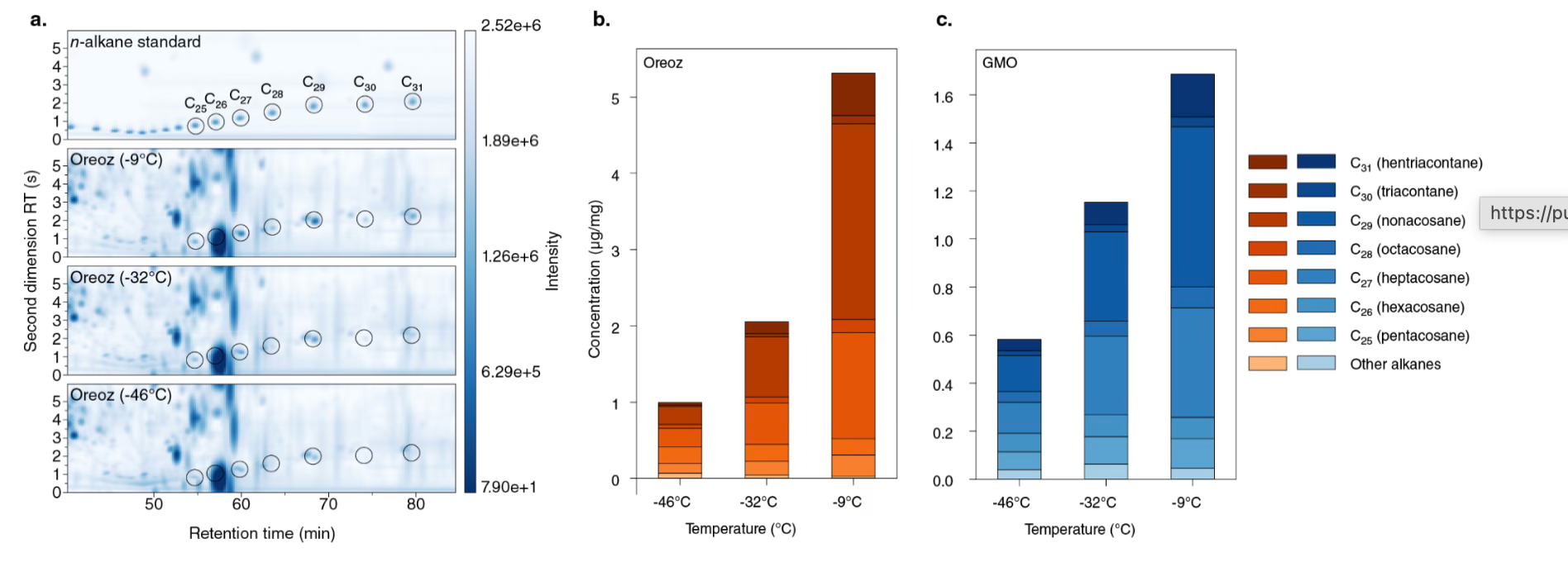
Lower extraction temperatures reduced wax-derived alkane content in the extracts. At the same time, cannabinoid content and total quantified aroma compounds remained largely consistent across the same extraction range, suggesting that extraction temperature can significantly reduce wax carryover without materially affecting cannabinoid potency or aroma profiles.
The researchers also examined what happens when these extracts are vaporized.
Wax levels in the aerosol closely tracked wax levels in the starting extract, producing an approximately linear relationship between the two. This suggests that extraction conditions influence not only the composition of the extract itself, but also the composition of the aerosol generated during vaping.
For extraction operators, the findings help quantify observations that many have made in commercial production for years.
Cold runs produce cleaner extracts. Warm runs have more wax. Winterization is effective in removing wax. This study identifies the specific compounds that make up the wax fraction and puts numbers behind what operators have observed for years.
Importantly, the paper does not make any safety claims regarding these compounds. The authors note that the toxicological implications of inhaling these wax-derived alkanes remain an open question and warrant future research.
What the study does demonstrate is that extraction temperature is a practical and controllable process variable for managing wax co-extraction while maintaining cannabinoid potency and aroma profiles.
Key Findings
- The dominant compounds in the cannabis wax fraction were identified as long-chain n-alkanes. This is among the first studies to systematically characterize the wax fraction in hydrocarbon cannabis extraction, and the first to link extraction temperature to wax levels in vape aerosol.
- Lower extraction temperatures reduced wax-derived alkane content in both extracts and aerosols.
- Cannabinoid content remained largely unchanged across the temperatures studied.
- Aroma compound content remained largely unchanged across the temperatures studied.
- Wax levels in aerosol closely tracked wax levels in the starting extract.
- Extraction temperature provides a practical control point for managing wax co-extraction.
- Waxes did not materially affect viscosity.
We’re proud to have contributed to the study as a co-author through the aerosol sampling and vaping experiments, helping researchers better understand how extraction conditions influence the composition of vape aerosols.
Research download
ACS Omega is a peer-reviewed scientific journal published by the American Chemical Society. You can access the official publication, citation information, and supplementary materials through the journal website.